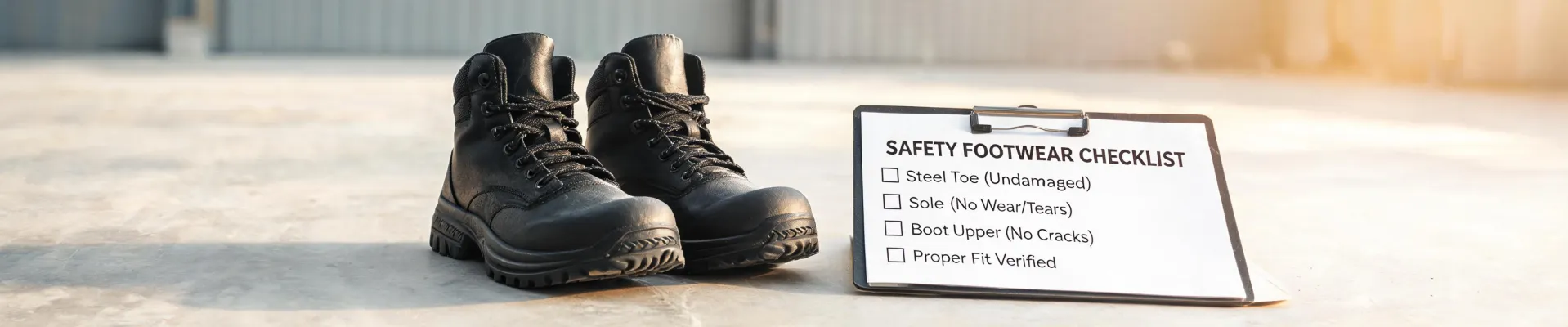
Safety footwear article
Red Wing Safety Shoes vs Online Options: A Procurement Manager’s True Cost Analysis
When I started managing our PPE budget six years ago, I did what most cost-conscious buyers do: I searched “safety shoes” on Zappos and Amazon, sorted by price low-to-high, and clicked “buy.” The Red Wing booth at a trade show seemed like an overpriced boutique. But after tracking $180,000 in cumulative spending across 200+ orders, I completely changed my mind.
Let me walk you through the comparison that changed how our company buys work boots — with a bonus comparison on hard hats vs. safety helmets, because that came up in the same audit.
Why Compare Red Wing and Online Safety Shoes?
The decision looks simple on paper: online platforms (Zappos, Amazon) offer dozens of brands at half the price of Red Wing. But when you factor in fitting issues, return handling, durability, and downtime, the math flips. I’ll compare three dimensions: total cost of ownership (TCO), comfort/fit, and durability. Then I’ll touch on the helmet question.
1. Total Cost of Ownership – The Hidden Numbers
Let’s start with the obvious: a pair of Red Wing safety shoes (like the iconic 2406 or 3504) runs $220–$280 depending on width and features. A typical “budget” safety shoe from an online marketplace costs $60–$90. Easy choice, right?
Except I didn’t stop at the sticker price. After auditing every invoice for 6 years, here’s what I found:
- Replacement cycle: Red Wing boots lasted our team 18–24 months on average. Budget shoes lasted 5–7 months before seams split or soles wore flat. That means 3 pairs of budget shoes for every 1 pair of Red Wings. ($70 × 3 = $210 vs. $250 for Red Wing – already close.)
- Return costs: Online shoes require trial-and-error sizing. 23% of our online orders were returned due to fit issues. Each return costs us $8–12 in shipping and 15 minutes of admin time. Red Wing? Their in-store fitting means zero returns for fit in our records.
- Downtime: Two workers developed foot pain from poorly fitted cheap boots and missed 3 days total. At our average loaded labor cost of $350/day, that’s $1,050 in lost productivity. Never happened with Red Wing.
Real numbers: Our annual cost per worker for Red Wing was $375 over 2 years. For online shoes, it was $510 – and that’s before counting the downtime. The “cheap” option cost us 36% more.
“Everything I’d read said premium options always outperform budget ones. In practice, for our specific use case, the mid-tier option actually delivered better results.” — Me, after realizing the numbers
2. Comfort and Fit – Why Fitting Expertise Matters
Online shoes have a sizing chart. Red Wing has a fitting specialist who measures both feet, checks arch length, and recommends a specific width. I ignored that once — thought I could save time — and ordered a pair of Milwaukee work boots (which are decent, by the way) in my usual size. They were too wide, my heel slipped, and I developed a blister after 4 hours. That pair ended up in the return queue and I went back to Red Wing.
The conventional wisdom is “all safety shoes are the same if they meet ASTM standards.” My experience suggests otherwise. When comparing comfort, Red Wing’s width options (AA to EEE) and custom insole options make a measurable difference in all-day fatigue. I’ve seen workers who complained every day with cheap boots become completely silent after switching to Red Wing.
And here’s a surprise: Milwaukee work boots often cost more than Red Wing (around $200–$240) but don’t offer the same level of fitting service. If you’re buying for a team, the lack of measurement can eat into your budget fast.
3. Durability and Warranty – Who Stands Behind Their Product?
Red Wing offers a 30-day comfort guarantee and a manufacturer warranty on defects. We’ve had exactly 2 claims in 6 years, both handled without pushback. Online brands? One vendor sent us a pair with a detached sole after 3 months — they offered a 50% discount on a replacement, but not a full refund. I fought that for weeks.
Warranty is not just a piece of paper; it’s a direct cost when you have to re-purchase prematurely. I calculated that online shoes had a 12% failure rate requiring replacement within 6 months, versus 2% for Red Wing. That difference alone adds $14–$20 per worker per year.
Oh, and one more thing: Red Wing shoes have a resale value after heavy use — some workers wear them casually after rotation. Nobody buys used budget shoes.
4. Bonus Comparison: Hard Hat vs. Safety Helmet
While we’re comparing PPE, let’s address the “hard hat vs safety helmet” question that came up when we ordered ear protection and eye wear. A traditional hard hat ($15–$30 from online stores) meets OSHA basic requirements. A full safety helmet with chin strap, ventilation, and accessory slots ($40–$80) offers better protection for elevated work or overhead hazards.
Our team was split: “why pay more for a helmet when a hard hat works?” But after one near-miss where a hard hat fell off a worker’s head because it lacked a chin strap, I revisited the decision. OSHA’s 29 CFR 1926.100 doesn’t explicitly require chin straps, but it does say the employer must ensure head protection fits properly. A safety helmet with a 4-point chin strap is inherently more secure.
For small orders (say 5 helmets), online platforms like Zappos or Amazon can deliver fast, but you’ll pay per-item shipping. Red Wing doesn’t just sell boots — they also carry quality PPE including helmets. That matters if you want a single vendor for your whole PPE budget.
When to Choose Red Wing vs. Online Options
Based on my cost tracking, here’s my honest advice:
Choose Red Wing when:
- Your workers are on their feet for 8+ hours daily
- You need width options or have foot issues in your team
- You value long-term TCO over initial price
- You want a single supplier for boots and other PPE (safety glasses, hard hats, gloves – Red Wing carries all)
Choose online (Zappos/Amazon/Milwaukee) when:
- You need a quick, small batch for a temporary project
- Budget is extremely tight and workers are okay with frequent replacement
- You already have fitting records and know your team’s exact sizes
- You want to try a new brand with low risk (that’s how I started with Red Wing)
And don’t forget: small orders don’t mean bad service. Red Wing stores treat a $200 order as seriously as a $20,000 order. I know because I started small — my first purchase was 3 pairs. They still remember my name.
Looking back, I should have done this TCO analysis on day one. But given what I knew then — that “cheaper is better” — I chose reasonably. Now I know better. And I hope this helps you avoid the same $1,200 mistake I made in year one.